
Why Classical AI Struggles with Exact Logic (And How Quantum Physics Fixes It)
Introducing the Universal Quantum Transformer (UQT) and the phenomenon of Crystallization.
The Geometry Problem
Large Language Models are marvels of statistical pattern matching. They can write poetry, generate production-ready code, and converse fluently in dozens of languages. Yet if you ask a massive, billion-parameter AI to perform exact multi-step modular arithmetic or spatial permutations, it frequently hallucinates.
Why does an AI that passed the bar exam struggle with math?
The answer is not a lack of data. It is a problem of geometry. Standard classical Transformers operate in unconstrained, continuous Euclidean space. But exact mathematical systems (like modular arithmetic or non-commutative algebra) are periodic, cyclic, and rigid. Think of the numbers on a clock face: after 12, you don't go to 13; you loop back to 1.
When you ask a classical AI to learn a circular rule inside a flat space, it is like forcing a square peg into a round hole. To make it fit, researchers rely on massive over-parameterization. The AI memorizes its way to a messy approximation, resulting in a delayed learning phase known in machine learning as grokking. But an approximation is still an approximation. It remains statistically fragile.
Enter the Universal Quantum Transformer
Instead of forcing discrete math into massive, flat classical matrices, the UQT leverages the native physics of quantum mechanics.
We map data tokens directly into the continuous phase amplitudes of a multi-qubit quantum register. Because quantum states are manipulated using geometric rotations, the architecture acts as a native geometric calculator. The rules of cyclic math and spatial permutations perfectly match the physical laws of how quantum waves interfere with one another.
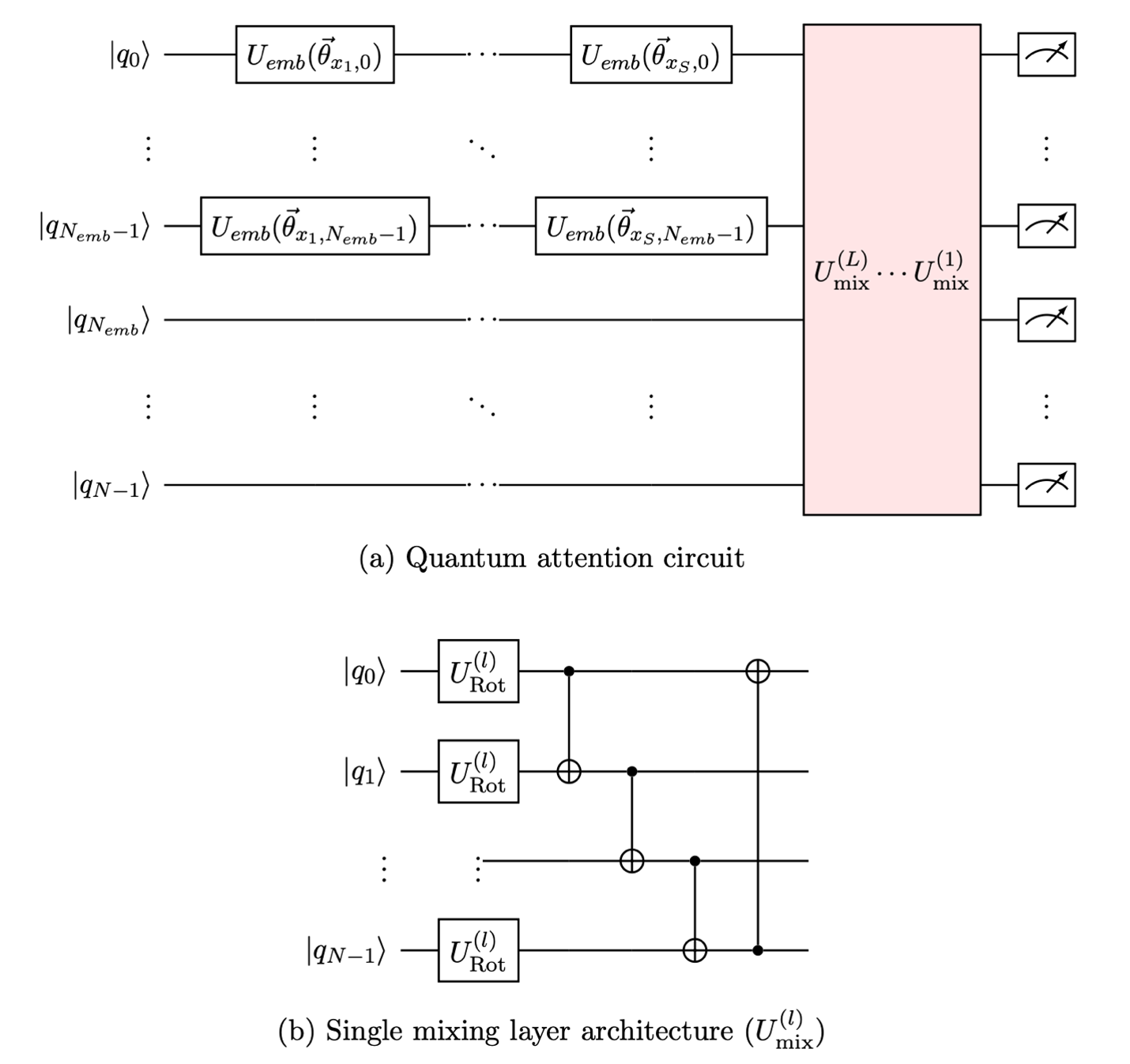
The architecture proceeds through four stages:
- Phase embedding: Inputs are encoded as quantum phase angles, mapping discrete tokens into SU(2) rotations on the Bloch sphere.
- Unitary composition: These rotations compose through matrix multiplication, preserving the non-commutative geometry of the group.
- Entanglement mixing: Multi-qubit entangling gates create correlations between qubits that have no classical analogue, producing exponential state space in linear qubit count.
- Measurement: Projective measurement collapses the quantum state to a classical output, completing the computation.
We pitted UQT against a standard classical Transformer on a series of complex mathematical tasks, including modular arithmetic and non-Abelian group permutations. The parameter difference was staggering: the classical network required roughly 400,000 parameters just to approximate the rules. The UQT required a 5-qubit register and fewer than 700 parameters.
From Grokking to Crystallization
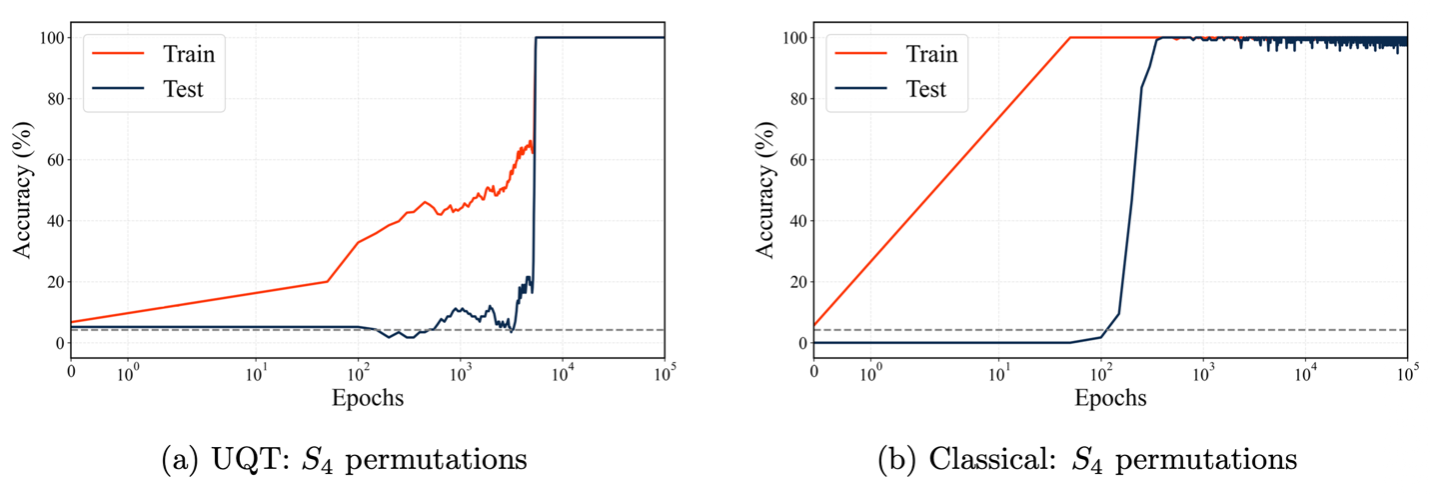
When classical networks attempt to learn exact math, they exhibit grokking. They memorize the training data, and only after a massive amount of extra training do they suddenly figure out the underlying rule. But even then, their understanding is shaky. Their test accuracy oscillates violently. They are guessing based on statistical probabilities.
The UQT does not just grok the data. It physically embodies the mathematical rules.
Because the quantum architecture perfectly aligns with the math, it achieves a state of zero-variance deterministic stability. Once it learns the rule, the accuracy locks at exactly 100% and never wavers. We call this new paradigm Crystallization.
Results
UQT has been validated across three fundamentally different algebraic domains:
- Modular addition (Z₁₁): 100% accuracy with 551 parameters, versus approximately 400,000 for a classical transformer. A 720x reduction.
- Modular multiplication (Z*₁₁): 100% accuracy with 551 parameters, same compression ratio, on a mathematically distinct operation.
- Permutation composition (S₄): 100% accuracy with 690 parameters on 576 equations defining the symmetric group of order 4, a non-Abelian group and the strongest test of universality.
All three domains achieved crystallization: zero variance on the test set, deterministic convergence, exact solutions. The classical baseline required approximately 400,000 parameters and still exhibited stochastic fluctuation at convergence.
Surviving the Real World: IBM Quantum Hardware
Simulations are great, but quantum computing is notoriously noisy. Could this highly compressed model actually run on physical hardware?
We compiled our trained UQT parameters and deployed them on physical IBM Quantum superconducting processors. Current NISQ hardware suffers from severe environmental decoherence: physical noise that scrambles quantum states.
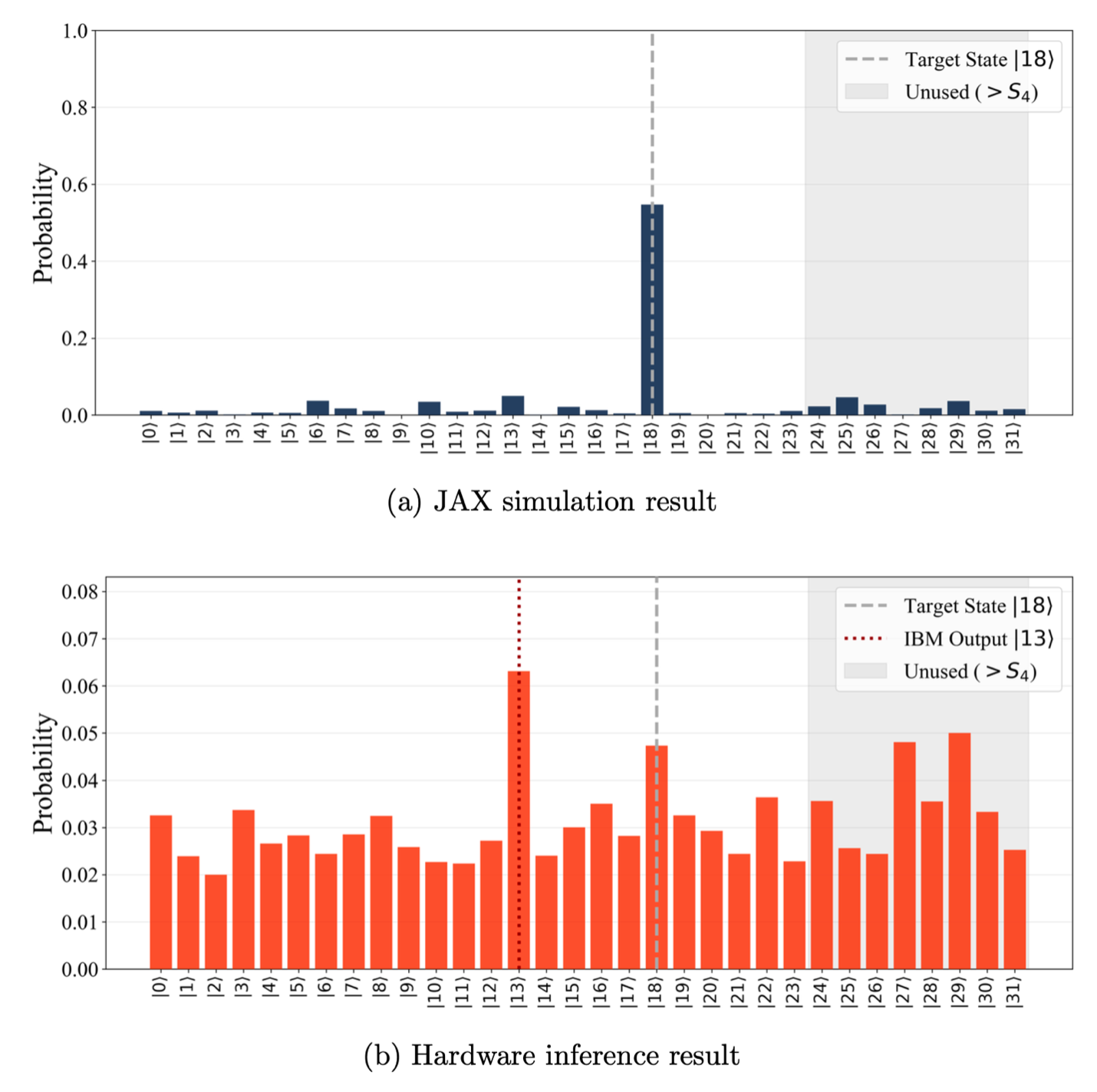
Remarkably, the geometric wave-interference learned by the UQT was incredibly robust. Across 30 unmitigated hardware evaluations, the UQT achieved an overall 96.7% success rate, including 100% accuracy on all unseen generalization test sets. It did not need quantum error correction; the model's geometry naturally protected the correct answer.
The one time it failed is actually the most interesting. During a highly complex non-Abelian permutation, the physical hardware experienced a noise-induced bit-flip. The machine predicted Class 13 instead of the target Class 18. However, when we examined the raw probability distribution, the true target was still the distinct second-most probable state. Even in its single failure, the UQT's geometric math successfully isolated the correct amplitude well above the random noise floor. The math was right; the physical hardware just blinked.
The Path Forward
The AI industry is currently trapped in a scaling race. To get models to reason better, companies build data centers that consume the electricity of small cities to train models with hundreds of billions of parameters. But the path to better AI will not be paved with trillion-parameter models. It will be built on better physics.
Our research proves that massive over-parameterization is not the only way to achieve exact algorithmic reasoning. If you match the architecture's geometry to the problem, you can compress the required parameters logarithmically.
Solving math is just step one. If we can compress complex, multi-step logic into a highly efficient quantum state space, the next step is applying this architecture to reasoning, code generation, information extraction, and multimodal understanding. We are building a company to scale this technology into the next generation of foundational models.
UQT runs on classical hardware today through UQT-Sim, a classical simulation of the quantum circuits. No quantum computer is required for inference. As quantum hardware matures, it extends the advantage further, but the architecture delivers value now.
Read the full research paper